The Place of the Skull
Then delivered he him therefore unto them to be
crucified. And they took Jesus, and led him away. And he bearing his cross
went forth into a place called the place of a skull, which is called in
the Hebrew Golgotha: Where they crucified him, and two other with him, on
either side one, and Jesus in the midst.
John 19 (vss 16-19)
The specific use of the word place in the description of Golgotha
hearkens back to the the prophetic verses of Genesis 22, the
Genesis of the Cross, and the
place that God told Abraham to
sacrifice his beloved son Isaac. We read:
And it came to pass after these things, that
God did tempt Abraham, and said unto him, Abraham: and he said, Behold,
here I am. And he said, Take now thy son, thine only son Isaac, whom thou
lovest, and get thee into the land of Moriah; and offer him there for a
burnt offering upon one of the mountains which I will tell thee of. And
Abraham rose up early in the morning, and saddled his ass, and took two of
his young men with him, and Isaac his son, and clave the wood for the
burnt offering, and rose up, and went unto the place of which God had told
him.
The word used in this verse is:
Place ( , Maqom) = 186 , Maqom) = 186
This coincides exactly with the value of the word written in John 19:
Golgotha ( ) = 186 ) = 186
The vast and far reaching parallels between the prophecy of Genesis 22 and the crucifixion
of the Lord Jesus Christ are discussed on Spoke 22.
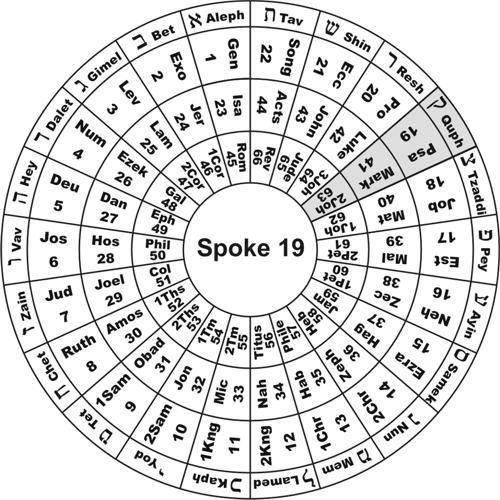
This Number also coincides with the value of the name of the 19th Letter:
Quph ( , Eye of a Needle) = 186 , Eye of a Needle) = 186
The meaning of Quph is clear from how Jesus used it in
Matthew 19.
It represents the narrow way of the Cross, self-denial, the crucifixion of the
flesh. Yet there is more. In Revelation 16.7, we read:
And the seventh angel poured out his vial into the air; and there came a great
voice out of the temple of heaven, from the throne, saying, It is done.
The word written is:
 (gegonen) = 186
This word differs from the word Jesus used on the Cross, tetelestai,
which will be discussed elsewhere. Gegonen first occurs in verse 22 of Matthew 1, in referrence
to the fulfillment of prophecy:
Now all this was done, that it might be fulfilled which was spoken of the Lord by
the prophet, saying, Behold, a virgin shall be with child, and shall bring forth a son,
and they shall call his name Emmanuel, which being interpreted is, God with us.
We have a four-fold set:
| The Number 186 |
Quph, The Eye of a Needle - |
| Place - |
| Golgotha - |
| It is Finished! - |
The word maqom (place) is from the root qum ( ),
which means to stand, arise, or raise up. God used it twice in the alphabetic verses: ),
which means to stand, arise, or raise up. God used it twice in the alphabetic verses:
- AV Lam. 2.19: Arise, cry out in the night: in the beginning of the watches pour
out thine heart like water before the face of the Lord: lift up thy hands toward him for
the life of thy young children, that faint for hunger in the top of every street.
- AV Pro. 31.28: Her children arise up, and call her blessed; her husband also, and he praiseth her.
Qumi! (Arise!)
Qum is a fundamental Quph KeyWord (cf. Quph Alphabetic Verses).
Christians are familiar with it through its
Aramaic cognate which Jesus used when He raised a young girl from the dead, saying
Talitha cumi, which means "young girl, arise" (Mark 5.41). Cumi
is an Aramaic variation of qum. This word Jesus spoke is a KeyWord for themes based on the letter Quph.
God's careful placement of this transliterated Aramaic word here on Spoke 19 and
nowhere else in all the New Testament, yields yet another lucid testimony of the
supernatural integration of Scripture with the Hebrew alphabet.
Golgotha is the place (maqom) where Christ was lifted up (qum), in fulfillment
of His own words when He said:
And as Moses lifted up the serpent in the wilderness,
even so must the Son of man be lifted up: That whosoever believeth in him should not perish,
but have eternal life. For God so loved the world, that he gave his only begotten Son,
that whosoever believeth in him should not perish, but have everlasting life.
John 3.14
And again:
Then said Jesus unto them, When ye have lifted up the Son of man, then
shall ye know that I am he, and that I do nothing of myself; but as my Father hath taught
me, I speak these things. And he that sent me is with me: the Father hath not left me
alone; for I do always those things that please him. As he spake these words, many believed
on him."
John 8.28
All of this integrates with the Biblical teaching of the dual nature of unbeliever's response
to the Cross, as explained on in I Corithians on Spoke 2 (I Cor 1.23):
For the Jews require a sign, and the Greeks seek after wisdom: But we preach Christ
crucified, unto the Jews a stumblingblock, and unto the Greeks foolishness; But unto them
which are called, both Jews and Greeks, Christ the power of God, and the wisdom of God.
As an aside, these verses reflect the difference between Greek and Hebrew epistemolgy, or
way of knowing. The Hebrew yado (to know) relates to yad (hand) and the idea
of touch (cf Genesis 4) whereas the
closely related Greek word ido (to know) relates to video, to
see. Hence the "Jews require a sign" (physical knowing) while the "Greeks desire wisdom" (ideational
knowledge).
Returning to our main theme, the dual nature of this stone of stumbling was prophesied
in Isaiah 8:13f
Sanctify the LORD of hosts himself; and let him be your fear, and let him be your
dread. And he shall be for a sanctuary; but for a stone of stumbling and for a rock of
offence to both the houses of Israel, for a gin and for a snare to the inhabitants
of Jerusalem. And many among them shall stumble, and fall, and be broken, and be
snared, and be taken.
The exact words written are:
Stone of Stumbling (אבן נגף , Ehven Neguph) = 186
This Number is deeply integrated with the idea of stumbling and other Quph KeyWords.
Consider this verse from Isaiah (vs. 28.7):
But they also have erred through wine, and through strong drink are out of the way;
the priest and the prophet have erred through strong drink, they are swallowed up of wine,
they are out of the way through strong drink; they err in vision,
they stumble (  ) in judgment.
For all tables are full of vomit ( ) in judgment.
For all tables are full of vomit (  , Qia)and filthiness, so that there is no
place ( , Qia)and filthiness, so that there is no
place ( , Maqom) clean. , Maqom) clean.
These two verses, while not geometrically integrated on the Wheel, do display the thematic
integration of the two fundamental Quph KeyWords with the idea of stumbling and the
Number 186. The word translated as "they stumble" (paku) is an anagram of Quph!
All of this integrates not only with the meaning of the Nineteenth Letter, but also with the
numeric value of its name, as noted above.
Gershom Scholem, in his seminal work on Jewish Mysticism (Kabbalah, pg. 341),
discussed how the
ancient Jewish tradition associated the word Makom (Place) with the divine Name YHVH by
calculating the sum of the square of the value of each letter:
Inner Square Sum of YHVH ( ) = 52 . 62 . 52 .
102 = 186 ) = 52 . 62 . 52 .
102 = 186
This integrates with the values noted above:
Place = 186 = Golgotha
This naturally integrates with the idea of the Death of the Lord Jesus Christ at the Place called
Golgotha. The square form of numbers relates to the Number 4 (the first non-trivial square) and its
associated ideas of weakness, death, and self-sacrifice (cf. Dead Four Days).
As discussed in the Dalet Alphabetic Verses the phrase "Jesus died" is
;numerically equivalent to the square of the traditional age at which he died:
| Jesus died

Iesous apathenon |
= 1089 = 33 x 33 |
| 
 Home
Home
 Golgotha - The Place of the Skull
 Printer Friendly Version