Page 4 of 8
Re: Number 1 is the first prime
Posted: Mon Mar 09, 2026 4:44 pm
by Alex
And my weekly AI limit just got reset so I am afraid I can't comment here until Friday when I have used it up.
I can't debate people when I got that much to do as I just get angry fast when I got my hands full. And I am working on a database.
So goodbye until then.
Re: Number 1 is the first prime
Posted: Mon Mar 09, 2026 5:00 pm
by Megiddo
Alex wrote: Mon Mar 09, 2026 4:03 pm
I mean you just suck big time, that is the truth. Because when you can't win a debate, you tell others to quit and "that no one cares about your stuff".
And you never play fair, what is wrong with you? You can't just pull up division of numbers here and pretend that you can compare it to the UC method.
You absolute joke.
488/3016 = 0.161803
48 = 3x16 --- 316 = C.Tri(15 = Tri(5 = PP-o(37))) = C.Hepta(3+7) = CW of Vs(777)
C.Tri(15).png
Sir, are you okay? You just said I can't use division and then proceeded to use division (488/3016) LOL! Even worse is you seem to have forgotten that
the "UC" method also uses division! 
The "UC method" is the number of words multiplied by the total value and then
divided by the number of letters multiplied by the total value. You had to perform this TOTALLY UNWARRANTED calculation just to get to Phi when my example was simply the name of Jesus Christ divided by the key "love verse" of the Bible (which gives a BETTER approximation of Phi).
Look at what you just did too: You treated 488 as if it was 48 and then treated 3 × 16 as if it was 316. The reason you have to keep manipulating numbers like this is because you can't find anything with the actual numbers. That's why you need to find a new hobby.
Why even place significance in the sum of two central word values of a given verse? Why not the sums of the three central word values or four central word values?
I've seen alot of bad numerology but yours is probably the worse I've ever seen (especially because you're using the Bible to do it, thereby making the Biblical Mathematics community look like nutballs).
2368 created the universe,
Leo
Re: Number 1 is the first prime
Posted: Mon Mar 09, 2026 8:17 pm
by Megiddo
The Phi ratio of 754 that I showed is also tied to the prime/composite numbers indexed to 73 (further demonstrating that 1 is to be excluded from the primes):
P = Prime numbers and C = Composite numbers
754 / (P73 + C73) = 1.61803
We know the golden ratio is found throughout creation. Therefore, it is fitting indeed that this is also tied to Proverbs 3:19, which deals with creation:
Proverbs 3:19
"The LORD by WISDOM hath founded the earth" (SH) = 466
"Jesus Christ" (SH) = 754
754/466 = 1.61803
"Wisdom" (OH) = 37 and "Wisdom" (SH) = 73
The foundational creation verse = Genesis 1:1 = 37 × 73
2368 is God,
Leo
Re: Number 1 is the first prime
Posted: Tue Mar 10, 2026 1:03 am
by Alex
Well, I messed up stuff today because of bad sleep so the database work will have to wait until tomorrow.
And if you can't come with any substantial evidence of 2 being prime that beats my evidence, then please don't try to willynilly into other ways of "getting me" here. It's really pathetic to watch.
And I know many people see you as a significant person in this community, but at least they can see just how low you go here.
The fact that you discard the UC method and compare its significance to a division of two numbers is just terrible.
If I did not know better, then I would label you as a noob. But you are just arrogant.
I will not respond to your cheap, unfair and silly tricks. I will only respond to serious stuff from you now.
So you better come with a good prime number 2 code with a probability that is at least 20 million if you want to look good in this debate.
I am not going to allow myself be brought down to your high school mentality.
I take gematria very seriously unlike you who will make your own rules and use tricks to win.
That is how it is now, and you can thank yourself for it.
You just throwed one of the most incredible methods of these codes in the trash just because you had to be right.
Absolutely insane. You are unhinged.
Re: Number 1 is the first prime
Posted: Tue Mar 10, 2026 11:19 am
by RAMcGough
Alex wrote: Sat Mar 07, 2026 6:33 pm
The main rule of prime numbers is that a prime can only be divided by and itself.
Therefore in a straight logical sense, 1 has to be the first prime.
And 1 was the first prime for the most part of human history until the mathematical community decided to change it to number 2 being the first prime for
conveniance sake. Not for logical reasons but in order to make neat statements like this:
"A prime number is a natural number greater than 1 that has exactly two distinct positive divisors."
But there are published mathematical papers using 1 as the first prime until the year of 1956.
The "Unique Building Block" Rule
The main reason for excluding 1 was to protect a cornerstone of mathematics: The Fundamental Theorem of Arithmetic.[5][6][7][8] This theorem states that every integer greater than 1 is either a prime number itself or can be expressed as a unique product of prime numbers.[5][8]
Think of primes as the fundamental building blocks of all other numbers.
The unique prime factorization of 12 is 2 x 2 x 3.
Now, let's see what happens if we allow 1 to be a prime number:
12 could be 1 x 2 x 2 x 3
Or 1 x 1 x 2 x 2 x 3
Or 1 x 1 x 1 x 2 x 2 x 3
Suddenly, the factorization is no longer unique; you could include an infinite number of 1s. This breaks the elegance and power of the theorem. To avoid this, mathematicians decided it was much simpler to refine the definition of "prime" to specifically exclude 1.
Gemini
So instead of saying that 1 is prime and then excluding it from rules as we have seen before, they just took the liberty to change 1 from being prime to not being prime. Because you know that is simpler. But it is not the correct thing to do as we see number 1 being unique and excluded from certain rules when it comes to polygons & polygrams aka figurate numbers.
All standard Polygons & Polygrams start with number 1 as the first order, even though 1 does not resemble any shapes of these polygons in its form.
Yet, we consider 1 as the first polygon or polygram and even God agrees here since we see the Genesis 1:1 codes respect that rule.
So why did we not exclude 1 from polygons & polygrams when we excluded it from primes? I have no answer for this so go ask the mathematicians.
So you can choose convenience or logic here. Logic says that number 1 is prime, while convenience says that 1 is not prime.
Do you really think that God will choose convenience here? Well, he won't,
The fact is that you can use either number 1 or number 2 as the first prime when doing Bible codes.
But the best codes are found when you use number 1 as the first prime. That is my conclusion after doing testing, so well I guess it's my theorem.
I always use 1 as the first prime number, even in this thread. So now let's see what God thinks about the prime question.
Hey there Alex!
This is your best post yet, in my humble estimation. I love how you are reviewing the various options, using AI, and explaining your thought process. That's awesome!
I've always been hesitant to base any patterns on indexes because they're are usually two and sometimes even three optional starting points. For example, figurate numbers are defined by a mathematical formula, so they usually start with the index 1 and the value 1 (e.g. first square = 1 x 1 = first triangle = 1 x (1+1)/2 etc.). And of course primes can start with 1 or 2. So for me, I would have to find some way to discern "God's intent" before I could confidently assert that God did anything at all with the indexes.
The hex/star pair of Genesis 1:1 seems of great significance, since the indexes are mirrored composites that correspond to the mirrored primes, and the concept of mirrored symmetry is absolutely central to Genesis 1:1 because the hex/star pairs are created by a symmetric operation of self-intersecting a symmetric equilateral triangle T(10) = 55 and the mirrored symmetry of the Genesis primes 37/73 is continued in the mirrored symmetry of the semiprimes of John 1:1 and these combine to create yet another equilateral symmetric triangle T(112)
Genesis 1:1 = 37 x 73 (mirrored primes)
John 1:1 = 39 x 93 (mirrored semiprimes)
Genesis 1:1 + John 1:1 = T(112).
That's a LOT of symmetry! So the fact that 37 = P(12) and 73 = P(21) perfectly coheres with and reinforces the mathematical elegance of these creation verses. This feels like the work of God to me.
Alex wrote: Sat Mar 07, 2026 6:33 pm
So the fine-structure constant (α): 1/137.035999203 = 0.00729735256
governs the electromagnetic force between two charged particles like an electron and a proton.
This is the most mysterious constant since we don't know why its value is 137.
But this constant is extremely important in the Bible codes and we see Gen 1:1 is verse# 1 "α".
red W#1 + ord W#3 + std W#7 of Gen 1:1 is 13+41+296 = 350 = 10x 35 "proton" (E r)
red W#1 + ord W#3 + std W#7 of Gen 1:1 in reverse direction is 17+62+913 = 992 = 92 "electron" (E o) with an extended digit
Sum = 1342 = TV of Vs(13 = Pri(7))
I love your understanding of the fine structure constant. I believe that's a significant part of why God encoded it in John 1:1-5. We have the following identities:
"All things were made by him" = 2055 = 15 x 137
Sum of John 1:1-5 = 27615 = 13 x 2055 = 13 x 15 x 137
These identities follow but one rule: standard Greek gematria. The values are totally determined by what is written. Thus I can have great confidence that God designed them (
see here).
Unfortunately, your pattern is very different. You have an infinite set of possible combinations that enables you to "connect" pretty much anything to anything. Let me explain
You could have chosen any combination of red, ord, std for the sum. There are 27 such possible combinations. Here they are listed out.
(red, red, red)
(red, red, ord)
(red, red, std)
(red, ord, red)
(red, ord, ord)
(red, ord, std)
(red, std, red)
(red, std, ord)
(red, std, std)
(ord, red, red)
(ord, red, ord)
(ord, red, std)
(ord, ord, red)
(ord, ord, ord)
(ord, ord, std)
(ord, std, red)
(ord, std, ord)
(ord, std, std)
(std, red, red)
(std, red, ord)
(std, red, std)
(std, ord, red)
(std, ord, ord)
(std, ord, std)
(std, std, red)
(std, std, ord)
(std, std, std)
This is why I say your results look cherry picked from a random set.
Think what this means. We're discussing how to tell if God designed his patterns using either 1 or 2 as the first prime. That's just one choice, and yet it's very difficult to prove either way. Multiply that by 27 for just your first example. And then you added other arbitrary variations like your "reverse" method and your "with extension" method, so the total number of possibilities for just those two lines explodes to at least 108 by my count. This is the fundamental problem with you method.
Do you understand my point?
God bless you my friend. And thanks for starting such an excellent thread.
Richard
Re: Number 1 is the first prime
Posted: Tue Mar 10, 2026 1:20 pm
by Megiddo
Alex, your evidence for 1 being prime objectively sucks. Very badly, in fact. All I see from you is repeated use of arbitrary methods (without justification), endless cherry picking with dozens of methods and constant manipulation of numbers (i.e. twisting/butchering them into different numbers).
Your reasoning for treating 1 as prime, versus my reasoning for excluding it (the fact that primes CREATE numbers and 1 doesn't), is very poor as well. Your only real argument is that people used to treat 1 as prime. So what? People used to wipe their butts with leaves too. That's not really a good argument. Moreover, Biblical Numerics was uncovered when 1 was already excluded universally from being prime. Why would God give us prime codes beginning with 1, to be uncovered in our generation, when the idea of 1 being prime is universally rejected?
As far as I know, you're the only researcher in this community who treats 1 as prime. Actually, I take that back because I don't even consider you to be a researcher in this community. I see you as a TROLL in the community who keeps posting these long chaotic posts of meaningless dribble that nobody even understands. In a way, it's good that you're here so that people can see the difference between authentic Biblical Numerics and your ridiculous number games.
You're basically a necessary evil.
The fact that you can't understand why a division between two numbers is much more natural than applying the "UC" method is really baffling. The UC consists of applying multiple steps that are, in your case, totally unwarranted! Furthermore, I didn't just divide any two numbers. The numbers are derived from the Hebrew name of "Jesus Christ" (754), the key "love verse" in the Bible (yielding an Ordinal value of 466), a key "creation passage" (yielding a Standard value of 466) and they give a better approximation of Phi than you got (754/466 = 1.61803).
Btw, I don't deny the UC code of Genesis 1:1/John 1:1, which you had nothing to do with. However, your method of finding "codes" by applying the UC to every verse in the Bible is debunked by these very two verses wherein this calculation was originally found (Genesis 1:1/John 1:1). How? Very simple:
● The UC applied to Genesis 1:1 yields the CLOSEST approximation of Pi compared to any other verse in the Bible
● The UC applied to John 1:1 yields the CLOSEST approximation of E compared to any other verse in the Bible
What does this show? It shows that the UC method is UNIQUE to Genesis 1:1/John 1:1, which are themselves related (being the two key "creation verses" of the OT/NT). This is totally different from applying the UC to a random verse or phrase to get an approximation of some constant.
Can you show any other two related verses or phrases where the UC of each of them yields the CLOSEST approximations of two important constants (out of any two possible verses or phrases in the Bible)? If not, then you have no warrant or justification for applying the UC to any isolated phrase, which is all that you did. There's nothing self-authenticating about it, whereas the UC of Genesis 1:1/John 1:1 is totally self-authenticating.
2368 created the universe,
Leo
Re: Number 1 is the first prime
Posted: Tue Mar 10, 2026 1:24 pm
by Alex
Hello Richard, Glad you liked this post. But I am not sure what you mean here when you say 27 possibilities here since you must refer to this:
red W#1 + ord W#3 + std W#7 of Gen 1:1 is 13+41+296 = 350 = 10x 35 "proton" (E r)
red W#1 + ord W#3 + std W#7 of Gen 1:1 in reverse direction is 17+62+913 = 992 = 92 "electron" (E o) with an extended digit
Sum = 1342 = TV of Vs(13 = Pri(7))
When you use the three gematria systems then there are only 5 possibilities:
red
ord
std
o+s
r+o+s
That's it. You can't do this:
r+o
r+s
s+s
r+r
...
Here is the probability of the 3 Triangles found in Gen 1:1 & John 1:1 since Ithink you will find it interesting.
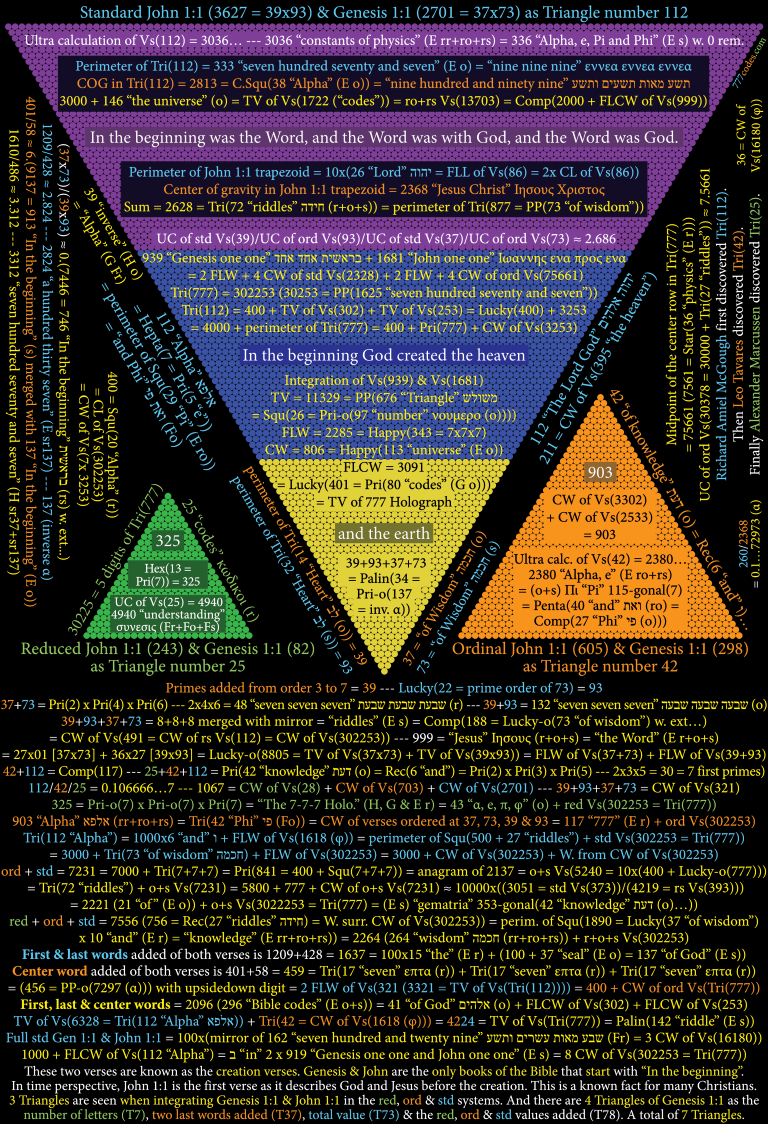
- Triangle 112 (Medium).png (918.17 KiB) Viewed 21356 times
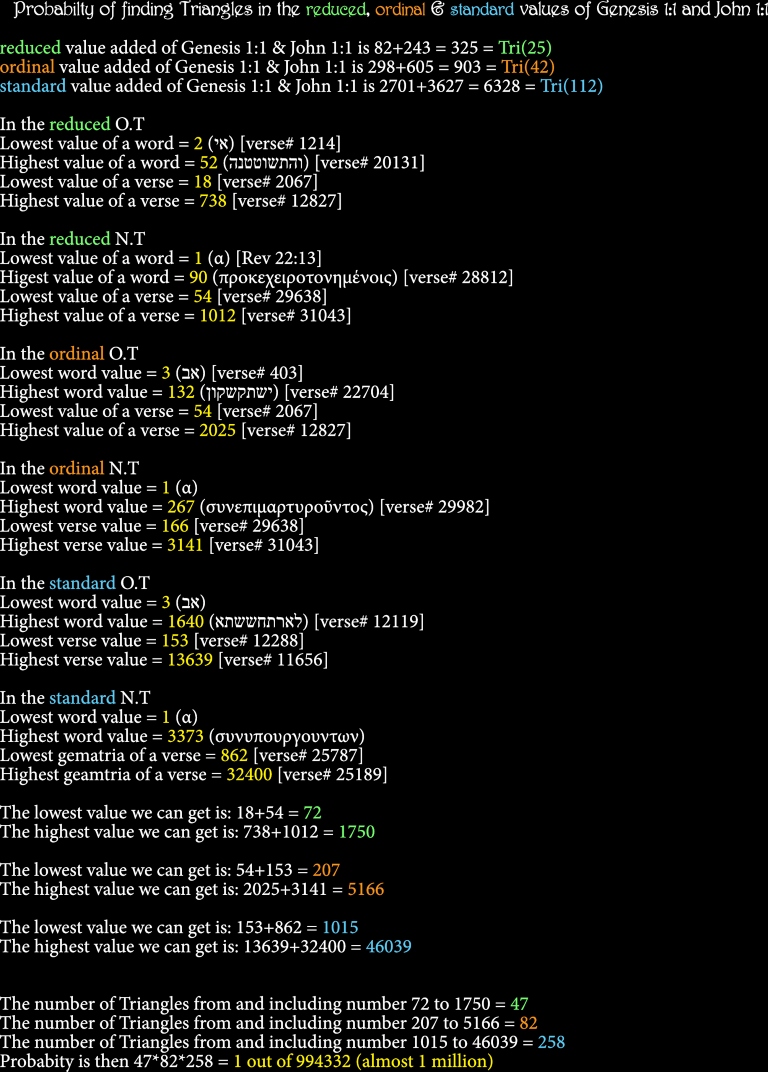
- Probability of Creation Triangles (Medium).png (278.25 KiB) Viewed 21356 times
Re: Number 1 is the first prime
Posted: Tue Mar 10, 2026 1:33 pm
by Alex
It should say Probability in the end there, but I can never get stuff 100% grammatically perfect when I write a lot of text.
I need to go through it at least 2 times to get it correct. And I deleted the file after I was done with that image.
Re: Number 1 is the first prime
Posted: Tue Mar 10, 2026 1:58 pm
by Megiddo
Alex wrote: Tue Mar 10, 2026 1:24 pm
When you use the three gematria systems then there are only 5 possibilities:
red
ord
std
o+s
r+o+s
No, there are 15 possibilities because you use three languages:
Hebrew (S), (O), (R), (S + O), (S + O + R)
Greek (S), (O), (R), (S + O), (S + O + R)
English (S), (O), (R), (S + O), (S + O + R)
With 15 possibilities applied to two massive books (the Hebrew/Greek Bible and the english KJV), you can create almost any pattern you want. Not only that, you can use those 15 possibilities in COMBINATION with each other!
Your methodology is garbage.
Re: Number 1 is the first prime
Posted: Tue Mar 10, 2026 2:13 pm
by RAMcGough
Alex wrote: Tue Mar 10, 2026 1:24 pm
Hello Richard, Glad you liked this post. But I am not sure what you mean here when you say 27 possibilities here since you must refer to this:
red W#1 + ord W#3 + std W#7 of Gen 1:1 is 13+41+296 = 350 = 10x 35 "proton" (E r)
red W#1 + ord W#3 + std W#7 of Gen 1:1 in reverse direction is 17+62+913 = 992 = 92 "electron" (E o) with an extended digit
Sum = 1342 = TV of Vs(13 = Pri(7))
You could just as easily have done this:
std W#1 + red W#3 + ord W#7
or this:
std W#1 + std W#3 + std W#7
or this:
ord W#1 + red W#3 + std W#7
or this:
red W# + ord W4 + std W#
or ... etc., etc., etc.... to infinity and beyond!
There are 27 different ways of combining three words using red, ord, std.
And there are many ways you could have chosen which words to combine (1,3,7 or 1, 4, 7) etc.
And you chose to use w. ext and you chose to use reverse. It looks like an infinite ocean of random connections without any meaning at all.
Alex wrote: Tue Mar 10, 2026 1:24 pm
When you use the three gematria systems then there are only 5 possibilities:
red
ord
std
o+s
r+o+s
That's it. You can't do this:
r+o
r+s
s+s
r+r
...
Do you have those rules written down somewhere?
Why can you do o+s but ot r+o? Why made up those rules? Why are they not consistent? Why should anyone believe them?
God bless you Alex.
Richard